How to Draw a Simple Storyboard for a Short Video
Learn how to draw a simple storyboard for a short video, clarify the visual story, and make useful filming choices with boxes, arrows, and a phone.
The common mistake with a storyboard is drawing every camera move before deciding what the pictures need to communicate. That costs time and can leave you with a tidy page that does not help when you pick up your phone. A simple storyboard for a short video works best when each panel clarifies an action, clue, or change.
Start with the story beat, not the camera
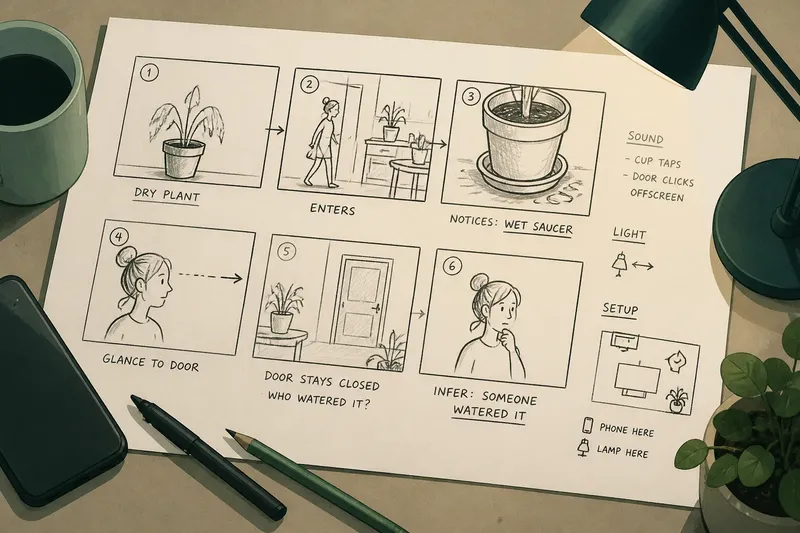
Write the scene’s essential change in one plain sentence before drawing. For instance: “Maya notices that someone watered her plant while she was away.” That sentence gives you a question to answer with pictures: what does Maya see, and what makes her suspect another person?
Think of a storyboard like a few objects arranged on a table before wrapping a parcel. You are checking what needs to be visible and in what order, not decorating the paper. Boxes, stick figures, and short notes are enough if they make the action readable.
Give each panel one visible job
Use a verb to describe what changes in each panel: enters, notices, reaches, hides, reveals. “A person in a kitchen” describes a place; “a person hides a note under a mug” gives you an action to draw and a reason for the next image.
Make the important shape easy to recognize. If the scene depends on a cracked phone screen, draw the phone large enough to read and mark the crack with a dark line. Skip details that do not help the viewer understand the beat, such as every cupboard handle or a carefully shaded counter.
Use a rough frame border to show what is inside the image. Place the subject and important object within it, then check whether a hand, edge, or busy background would hide the clue. An arrow can show a person’s glance or movement; add a short label if it might be mistaken for camera movement.
Choose panels that make the idea legible
Draw a new panel when the audience needs a different piece of information, not simply because time has passed. A closed lunchbox followed by an empty one suggests a change; two nearly identical pictures may be redundant unless the repeated image itself matters.
You can also leave a gap for the audience to fill. A panel showing a hand reaching toward a table, followed by an empty space where an object had been, may communicate more clearly than drawing every inch of the reach. Add a sound note only when it changes how the scene reads, such as “cup taps” or “door clicks offscreen.”
Make a storyboard that fits your room
Before filming, check the panels against the actual room and available light. Draw a small window or lamp symbol if its position matters, and mark where the phone and actor can fit. The sketch is a reminder of the visual idea, not a demand to copy an exact setup.
Say you have a phone, a kitchen table, a potted plant, and a desk lamp, and want Maya to infer that someone watered the plant. Draw a dry-looking pot, Maya entering, a wet saucer, and her glance toward a closed doorway. The wet saucer supplies a visible clue; the glance raises the question of who came in. If the lamp blocks the phone’s view of the saucer, move the lamp or draw a closer panel of the saucer, then keep whichever arrangement leaves the clue clear in the frame.
Keep the page nearby while filming, but revise it if the room makes a panel hard to read. If a planned view hides the important object, change the framing or shift the action. Preserve the story beat rather than forcing the room to match a drawing.
What should a simple storyboard show?
Do I need drawing skills to storyboard a scene?
No. Boxes, stick figures, arrows, and labels can show size, direction, and attention. If a drawing is confusing, simplify it until the action is easy to recognize.
How many panels should I draw?
Draw enough panels to show each meaningful visual change, such as an action, reaction, clue, or reveal. Add a panel when it supplies information the audience needs, not just to record every instant.
Should I include camera movement?
Include movement only when it changes what the viewer notices or understands. A short arrow labeled “follow the key” is clearer than a detailed sketch of the phone’s route.
Can I change the storyboard while filming?
Yes. Treat the drawings as a working aid and adjust them when the actual room, light, or phone position makes a panel unclear. Keep the central visual idea while changing the setup that delivers it.
Use the storyboard to protect the visual clue
Before filming, point to the panel that carries the main idea and check that the earlier pictures lead the viewer toward it. For this simple storyboard for a short video, the useful test is whether someone can follow the visible clue without needing you to explain the drawings.
Keep the page where you can glance at it between shots. A short note beside a panel—“saucer visible” or “door stays closed”—can preserve the detail that makes the scene understandable while leaving room for a better framing choice.